Manage heat and glare
Solar-control, neutral, reflective and insulation films can help reduce solar heat gain, screen glare and uncomfortable hot spots beside commercial glazing.
Explore commercial solar film →Digi Print coordinates survey-led commercial window-film projects across Manchester and Greater Manchester, from requirement and glazing assessment through specification, artwork, production and installation.
The right film depends on what the glazing needs to do, how the space is used and the construction of the existing glass. These three routes keep the project brief clear.
Solar-control, neutral, reflective and insulation films can help reduce solar heat gain, screen glare and uncomfortable hot spots beside commercial glazing.
Explore commercial solar film →Frosted, printed, patterned and opaque films suit meeting rooms, glazed partitions, clinics and other spaces that need consistent screening.
Explore office frosting →Manifestation, cut logos, printed gradients and branded patterns can make glass more apparent while bringing the surrounding environment into the brand system.
Explore manifestation and branding →Digi Print provides a practical range for commercial use, without a one-film-fits-all promise. Product availability and final construction are confirmed against the existing glazing, site conditions and project requirement.
Neutral, reflective and selected insulation films can help manage heat gain, screen glare and hot spots. Product choice balances performance, daylight and the external appearance of the building.
Privacy bands, full frost, patterned films, one-way daytime privacy and blackout options can be specified around the level and consistency of screening required.
Cut logos, printed graphics, gradients, decorative patterns and visibility markings can coordinate glazing with office, retail or hospitality branding.
Selected films can filter a high proportion of ultraviolet transmission and help slow fading. Film cannot prevent every cause of fading, so displays and sensitive contents still need a considered specification.
Protective film is a specialist, survey-led category. The glass, frame, selected film and any attachment system must work together for the intended risk and tested performance.
Internal application is common, but some glass constructions, access conditions and performance requirements may call for an exterior-grade product. The correct route follows glass identification and compatibility checks.
Reflective and one-way films usually provide daytime privacy when the exterior is brighter than the interior. They should not be sold as reliable night-time privacy.
Frosted, printed, patterned or opaque films are more appropriate where consistent privacy is required. The brief should also consider whether people need to see out, how much daylight should remain and whether the treatment is part of the brand.
One-way privacy depends on a light imbalance. If the inside becomes brighter than the outside after dark, the effect can reverse and people outside may be able to see in.
Where privacy must remain dependable throughout operating hours, a translucent, printed, patterned or opaque solution should be considered instead.
Compare the wider options before deciding whether a survey-led window-film specification belongs in the project.
Compare ventilation, blinds, external shading, fans, air conditioning and solar-control film without assuming one answer suits every building.
Choose between fixed and adjustable screening for meeting rooms, partitions, entrances and overlooked commercial glass.
Pane construction, orientation and site conditions affect compatibility and performance. A commercial survey is intended to establish enough information for a defensible specification.
Confirm the building use, affected rooms, operating hours, comfort or privacy problem, appearance requirements and access constraints.
Check pane size, glass construction, coatings, condition, orientation and whether the proposed film should be installed internally or externally.
Select a compatible film, confirm any artwork or manifestation, review installation access and set out the product-specific performance basis. Phased or out-of-hours installation can be discussed where practical.
Project discussions may cover glass-fragment retention, safety film, solar-and-safety combination film, security-delay systems and sacrificial anti-graffiti protection where an appropriate system can be specified. These are not interchangeable products and should not be selected from a generic description.
Safety and security performance depends on the complete specified system, including the existing glass, film, frame and any required attachment method. It must be assessed for each project.
A tested and correctly specified system may require a particular film construction, edge treatment or frame-attachment method. Performance should never be assumed from film alone.
This genuine Digi Print project at Beestro Café used frosted window graphics with cut branding to screen part of the glazed frontage while retaining a clear upper section.
It demonstrates Digi Print's established artwork and branded-glass capability. It is not presented as a solar-control or specialist protective-film installation.
View the Beestro frosting project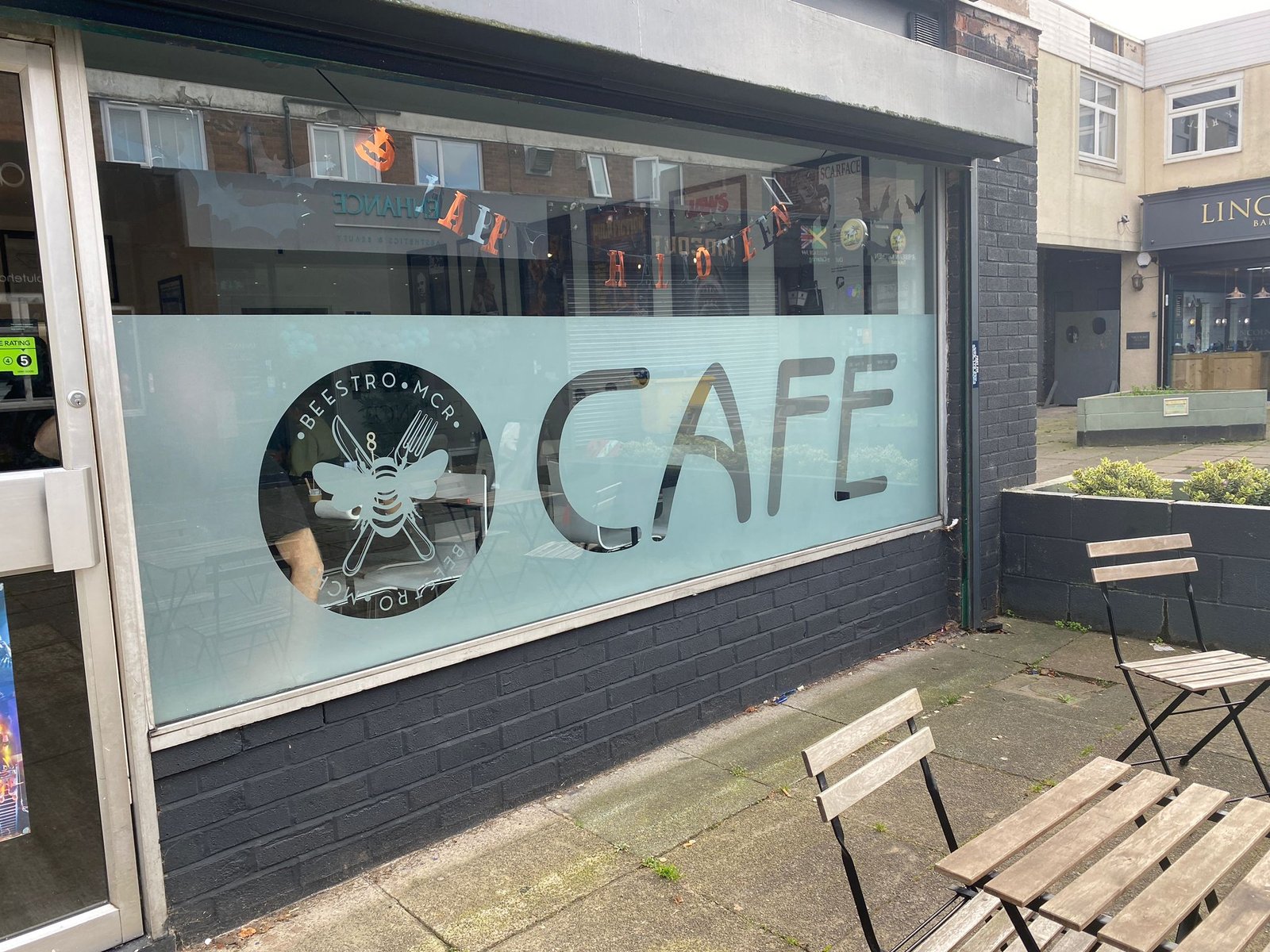
Digi Print coordinates commercial window-film projects across Manchester and Greater Manchester, with larger or multi-site requirements considered individually.
Options include solar control, glare reduction, office frosting, privacy, manifestation, decorative finishes, branded glass graphics, selected UV-control applications and survey-led specialist protective films, subject to the glazing and project requirement.
Usually not. Reflective and one-way films normally depend on the exterior being brighter than the interior, so the effect can reverse after dark. Frosted, printed, patterned or opaque films are more suitable where consistent privacy is required.
No. Film selection depends on the glass construction, condition, pane size, orientation, existing coatings and whether an internal or external product is appropriate. The glazing must be identified and checked before a final specification is agreed.
Solar-control and insulation films can help manage heat gain or heat loss and may reduce demand on cooling or heating systems, but project-specific energy savings require assessment. Digi Print does not guarantee a percentage reduction in total energy bills.
Safety and security performance depends on the complete specified system, including the existing glass, film, frame and any required attachment method. It must be assessed for each project.
Tell us what the building needs, where the glazing is and when the project is likely to move. Digi Print can review the requirement, discuss the survey route and prepare a quote around an appropriate specification.
An enquiry does not confirm product suitability or installation until the existing glazing, access and final specification have been assessed.
Prefer to talk?
07752 264 677
hello@digi-print.co.uk